
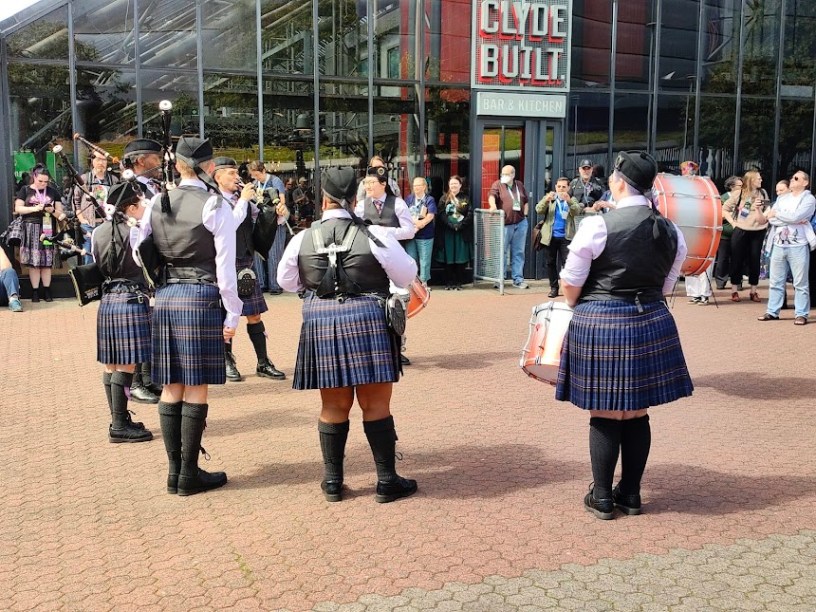
It’s a pleasure to be reporting from the 2024 Glasgow Worldcon, the 82nd World Science Fiction Convention, “a Worldcon for our futures,” held in the Scottish Events Campus on the banks of the Clyde. Despite Glasgow’s historic reputation as a cast-iron-and-coal Victorian industrial capital, the SEC is a suitably modernistic venue for a Worldcon, with the ovoid bulk of Sir Norman Foster’s Armadillo, the glass tent of the SEC Centre, and the attached Crowne Plaza Hotel providing much of the hospitality and function rooms. It’s also a particularly well sized venue for a Worldcon whose attendance runs into the high thousands. Current figures run at somewhere over 7,000 attendees onsite, as well as others with badges still to be claimed, and both figures are likely to rise—never mind the streaming audience who will be catching the show panels and events remotely.
In fact, after the earlier ructions over attempts to hack the Hugo Awards, this Worldcon appears to have run pretty smoothly. One or two events have been packed to capacity, but the organizers have made many of the most significant tracks available online. With multiple sessions, workshops, and speciality themed panels running simultaneously, one of the very, very few exasperations of this Worldcon is being literally spoiled for choice, with the plethora of fascinating options. Book vendors and dealers on the very extensive trade floor have said that the whole show has really exceeded their expectations—both in terms of sales, and just the ease of dealing with the venue and its facilities.
One sobering aspect of this Worldcon is the lingering legacy of COVID, still not entirely dispelled. Many attendees are wearing masks, especially those over from American conventions where COVID cases have been reported. The SEC Centre itself was briefly turned into a COVID-19 treatment centre during the pandemic, and my last visit here was for COP-26 in 2021, when attendees went through a double layer of screening for security and contagion testing. That’s no longer necessary, but the memory lingers—like something from a suitably science-fictional apocalyptic disaster movie.
Another sobering legacy is that of the mighty Iain Banks; but there will be plenty of space to write more on him, and the other great Scottish writers who have followed in his wake, later. Meanwhile, Scotland has a Worldcon it deserves, and Worldcon has a venue whose literary heritage enriches it.
 teleread.org